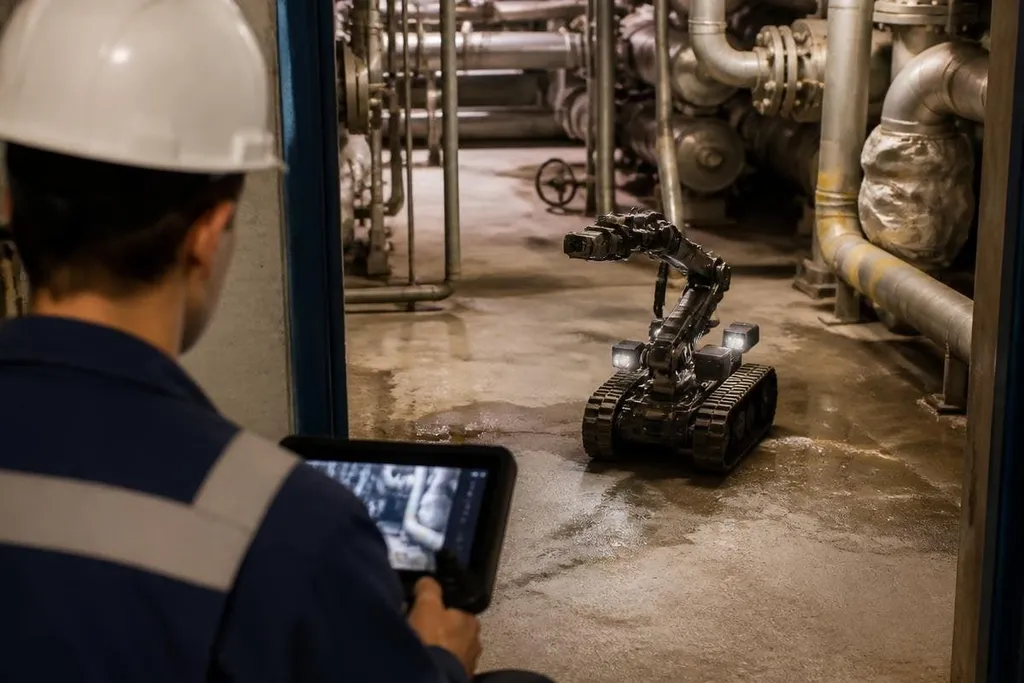
A nuclear plant can send a robot into a room where a person would need protective gear, dose limits, and a short work window. The machine can inspect pipes, valves, tanks, and floors while the operator stays outside the radiation area.
- Dose is measured in millisieverts, with 1,000 millisieverts equal to 1 sievert.
- Robots can inspect, map, carry tools, and move small items without putting a worker beside the source.
Where robots help
The clearest use is inspection. A tracked robot can carry cameras, lights, radiation sensors, and a small arm through a plant room. Its video gives the operator a view of leaks, loose parts, damaged insulation, or water on the floor before anyone enters.
That first look matters because a plant room may contain several hazards at once. Radiation can sit beside heat, standing water, sharp metal, poor lighting, and narrow access routes. The machine can check the route before a person brings in heavier equipment.
Robots also fit jobs that repeat. A machine can follow the same path around a tank or along a pipe while recording radiation readings at set points. The result is a map that staff can compare with earlier readings, provided the robot keeps the same route and sensor height.
Radiation changes the robot
A normal industrial robot may fail after enough radiation exposure. Radiation can damage camera sensors, memory, cables, motor controls, and battery systems. The robot therefore needs shielding, replaceable parts, or electronics chosen for a high-radiation setting.
The camera is often the part people notice first, but the drive system can decide whether the mission succeeds.
Tracks may work better than small wheels on rough floors, while a sealed body can reduce the chance that dust or water reaches the electronics. Every extra layer adds weight, which cuts runtime and makes recovery harder.
Communication also needs a plan. Radio signals may weaken behind thick concrete or steel, so the robot may use a cable for control and video. That cable gives a steady link, but it can snag on a door, pipe, or floor fitting. An operator must manage the route as carefully as the robot.
What the safety gain looks like
The safety gain comes from fewer person-hours near radiation, not from removing people from the process. Staff still set the task, check the machine, review its readings, and decide what action follows. The robot carries the sensor and takes the first risk.
A remote inspection can also shorten the time a worker spends inside a controlled area. The operator may first use video to find the fault, then send a person only when the job needs a human hand or a repair that the robot cannot complete.
A plant manager comparing systems should look for the robot model, radiation level, test site, and date in nuclear robotics reporting. Those details matter before the next section deals with a failed machine.
The limits are plain. The machine can lose traction, drop a tool, run out of battery, lose its link, or become stuck in a room that is hard for a person to enter. A failed machine may then add another object to recover, inspect, or shield.
What remains unproven
The available brief supplies no plant deployment, robot model, price, test result, or named source. That matters because a controlled demonstration does not answer the questions a plant manager must ask: how long does the robot run, how much radiation can its electronics take, and how often does it need recovery?
I'd reject any purchase claim that skips those figures. Nuclear work needs a record of dose, mission time, failures, repair time, and recovery steps for the exact site, not a video of a robot crossing a clean floor.
The machine may also collect poor data if its camera is dirty, its sensor faces the wrong way, or its position estimate drifts. Operators need checks against known radiation sources and fixed plant markers before they use the readings to plan work.
A buying checklist
Before a plant team approves a nuclear inspection robot, check these points:
- Map the room: Record doors, steps, pipes, floor gaps, water, and the areas where the signal may fail.
- Set the dose limit: State the radiation range, mission time, and sensor type the robot must handle.
- Test recovery: Show how staff will retrieve the robot after a stall, cable snag, battery fault, or lost connection.
- Check the data: Compare camera images and radiation readings with known points before using them for work planning.
- Count service parts: List spare batteries, wheels or tracks, cameras, cables, and control units that the plant can store.
That checklist turns a robot from a remote camera into part of a safety plan. The next useful proof will be a site record showing fewer worker entries, measured dose reduction, and recovery time after faults. Until those numbers appear for a real plant, nuclear robots are a safety tool worth testing, not a replacement for plant procedures.